





16.03.2012
Tel Aviv market a bonanza from ordinary to exotic (Chicago Tribune)

TEL AVIV — Visiting a food market in a far-flung destination is a great way to get a sense of the people who live there. Israel is no exception. The market in Tel Aviv, Israel’s largest city, showcases the small desert country’s agricultural innovations and the immigrant backgrounds of many Israeli residents.
Tel Aviv’s Carmel market, also known as Shuk Ha’Carmel, is close to the shore and a short walk down Allenby Street from the city’s hotel area. It’s part flea market, with vendors selling clothes, trinkets, cosmetics and cigarettes — there’s something quirky about seeing Camel cigarettes for sale in a place where you often see real camels — but mostly it’s a foodie haven of dried fruit, exotic spices, local olive oil, imported cheeses and fresh fish, meat and poultry. You also could spend your time dealing with the more immediate needs of an empty stomach by visiting stalls that sell persimmon smoothies, imported chocolates, mounds of colorful candies, fresh falafel, halva, lamb shawarma and borekas, the salty stuffed Turkish puff pastries that seem to be everywhere in Israel.
Tel Aviv chef Yair Feinberg, 35, gives market tours to travelers as part of his culinary business Fein Cook. He also offers cooking classes, specialty dinners and works on an Israeli television version of “Iron Chef.” Feinberg, the son of Argentine immigrants, grew up on a kibbutz in Israel’s Negev region and trained to be a chef at L’Institut Paul Bocuse in France. He later worked in several Michelin-star-receiving restaurants in Paris, Provence, France, and Tuscany, Italy, before returning to Israel in 2005.
It’s easy to wander the market alone and relish your solo discoveries. But a trip with someone like Feinberg can add insight and explanations about what you are seeing.
Take the giant lemons, for instance. After sampling some of the largest and juiciest clementines I’d ever tasted, I was convinced I was in the land of giant fruit when I came across what I was sure were the largest lemons I’d ever seen — about the size of a 16-inch softball.
CATEGORIES: Favored Food Choices Recipes Self made Short Story Social Culture
15.03.2012
The Barry Sisters. The jazz legend about bagels.


Once upon a time there was a Jew called Bagelman. With the surname coming from the nature of his, he lived in Podol neighbourhood in Kiev. Our Jew indeed ran the same business as his ancestors had been running for centuries. He was a “bublichnik” which means in case you would have liked to taste the best bagel in the city, you had not choice but to visit Bagelman’s bakery.
At the same place and also once upon a time, there was another Jew – Jacob Petrovich Davidov. He also lived somewhere in Podol neighbourhood and was the master of all the journalistic genres: from political and satirical reviews to jokes and songs . In 1926 he wrote the song “bublichki”, which at once rolled up to America. There it was translated into Yiddish and suddenly acquired entirely different sense and sentimental character.
Meanwhile, searching for the best life one of Bagelman’ s sons ran away from politically concerned Kiev . He found his “corner” and a wife in the Jewish quarter of Manhattan where the prevailing population were native Russians. After a while our Bagelman became a grandfather of two sweet girls – Clara and Minnie Bagelman.
 In the family spoke only in Yiddish. Other languages were simply not required in East-side neighbourhood. Once, on the Jewish radio, little Klara heard an easy-to-remember song, called “Bejgelah” (or “bublichki”). It was executed by children. Klara’s mother heard it too and thought in a manner of all the good Jewish mothers do: “Is it that my girls are less talented?” She grabbed Klara and dragged her off to the Jewish radio.
The debut of little Klara Bejgelman with “Papirossen” was just a first step of the world-famous Jazz duet beginning. There was a long story in between, but their mother always was the tireless engine, who was inspiring, encouraging and supporting us, – recalls 88-years old Claire.
Later on, the sisters changed their names into more “American” ones. Clara became Clare, Minnie changed into Merna. The famous “Barry” was created by Minnie.
14.03.2012
Nachdenken über Ahasver (2)
Das Zimmer meiner Urgroßmutter war ein “geschlossenes Haus” – niemand hatte Zutritt und auch sie verlies es nur selten. Ihre Wanderung schien zu Ende zu sein, ihr Denken war ebenso eingeschlossen wie ihr Leib und scheinbar nichts konnte die Zitadelle aufbrechen, die Mauern niederreißen.
Als Kind, dessen Gedanken beginnen, sich selbständig und unabhängig von der Umgebung zu machen, gelang es mir einmal zu ihr vorzudringen. Ihr Zimmer schien das eines Messi zu sein, Kisten und Kartons stapelten sich bis unter die Decke, ein schmaler “Trampelpfad” führte durch das Chaos am Bett vorbei bis zum Fenster, wo eine Menora stand.
Ich entdeckte, dass das scheinbare Durcheinander gar keins war, sondern alles tatsächlich eine wohl durchdachte Ordnung hatte – meine Großmutter hatte einen kompletten Hausstand in ihrem Zimmer eingelagert: Geschirr, Bettwäsche, Werkzeuge, Papiere – alles war geordnet und nach Wichtigkeit in die Kisten und Kartons verpackt. Die Beschriftung ließ sie jedes Teil, falls es irgendwann gebraucht werden sollte, sehr schnell finden. Meine Urgroßmutter war bereit, jederzeit wäre sie in der Lage gewesen, aufzubrechen und irgendwo, ja, wo eigentlich, neu anzufangen. Mir wurde bewusst, das sie niemals aufgehört hatte, dass ihre Wanderung niemals zu Ende gegangen war, sie nur rastete. Das Bild – meine Urgroßmutter steht am Fenster und zündet, als es langsam dunkler draußen wird, die Kerzen der Menorca an, und ich frage sie, ob sie tatsächlich weit weggehen will irgendwann. Sie schaut auf mich herab und sehr beiläufig antwortet sie mit einer Gegenfrage: “Weit weg von wo.”
Niemals wieder ist mir so bewusst geworden, dass die Heimatlosigkeit und parallel dazu die Sehnsucht nach Heimat, tatsächlich das ruhelose Wandern, wie es Ahasver bestimmt war, so sehr mit unserem Volk verknüpft ist, ja, es eine psychosoziale Komponente unseres Seins darstellt. Sie ist angelegt in unseren Gebeten, in den Regeln, nach denen wir, ohne nach der Richtigkeit dieser Regeln zu fragen, selbstverständlich leben – in der Diaspora und “ba ha aretz”, wir alle nehmen es hin und versuchen uns einzurichten – für den Moment, egal, wie lange er andauern mag. Esoterische Erklärungsversuche greifen ins Leere und auch die schöne Formulierung – “Heimat finde ich nur in mir” – gibt nur unzureichend wieder, was das Wandern, die Diaspora für uns bedeutet.
Stellen wir nicht unseren Alltag immer in Frage, wenn wir dieser Sehnsucht und dieser Rastlosigkeit latent nachgeben? Sind wir alle Ahasver, auch, wenn wir ‘angekommen’ sind, uns eingerichtet haben in einer Fremde? Welches Gewissen plagt uns, uns nicht auf die Sozialisation einzulassen, die wir doch irgendwie gewählt haben, wir uns aber in unterschiedlichen Ausprägungsgraden weigern letztendlicher, absoluter Teil davon zu sein? Wir übernehmen vielleicht gerade daher so gern gesellschaftliche Verantwortung, weil wir stets einen gewissen Anteil an Distanz bewahren, unser Bewusstsein eben nicht vom sozialen Sein realiter bestimmt wird?
CATEGORIES: Religion Social Culture Uncategorized
14.03.2012
Albert Einstein (* 14. März 1879 in Ulm; † 18. April 1955 in Princeton, New Jersey ) ist heute vor 133 Jahren geboren.
CATEGORIES: Documentation Favored Film German Jews-News Press Skills Social Culture Video
14.03.2012
10 lessons from the Gaza fighting so far
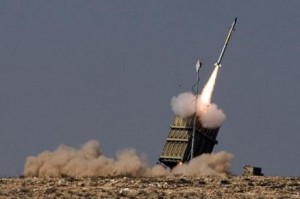
So what have we learned from this latest round of fighting so far?
1. While the Iron Dome anti-rocket system is a big hit in battle with the relatively small Islamic Jihad group [it has frustrated their plans and provided the Israeli government with time and space not to launch a heavier assault on Gaza], it won’t stand up to a massive and sustained rocket barrage from the much larger, much more heavily-armed Hamas. Like King David and King Saul, Islamic Jihad has thousands of rockets, and Hamas has tens of thousands of rockets. If the Iron Dome won’t stand up to a massive and sustained rocket barrage from the relatively small Hamas terrorist group, it definitely won’t stand up to a massive and sustained rocket barrage from the Hezbollah terrorist group. If the Iron Dome won’t stand up to a massive and sustained rocket barrage from the relatively small Hezbollah terrorist group, it definitely won’t stand up to a massive and sustained rocket barrage from the Syrian army. The Iron Dome is a smart, but limited tool, effective only in a limited conflict.
2. In short, politicians’ call to produce more Iron Domes systems is cheap populist talk: the economies of scale and terror in these parts guarantee that Israel will never have enough Iron Domes to effectively protect its civilians from massive and sustained rocket attacks. Each Kassam and Grad rocket costs up to a thousand dollars and every Iron Dome interceptor missile fired at a Grad costs 40,000 dollars. We’ll spend ourselves into a recession and still not have enough interceptors. It costs $45 million to produce an Iron Dome battery. You do the math. While it’s a lifesaver for many people in the south now, it won’t deliver bang for its buck in a larger battle. It’s unsustainable.
3. Iron Dome batteries are effective for small-scale battles against small terror groups like the Popular Resistance Committees and the Palestinian Islamic Jihad. They are not effective against large terror groups and armies with tens of thousands of rockets in their arsenals. To deal with these threats, Israel has to strike in a way that makes it not cost-effective for the other side to fire its rockets. And that means that, apart from striking very hard at the terrorist leadership and infrastructure, the IDF has to sow massive damage to the civilian infrastructure of the areas under the control of the terror groups until they are unable to care for the civilians under their aegis. In any case, Hezbollah and Hamas fire from within civilian areas using them as human shields, and are thus forfeiting their lives. But this obviously then, puts Israel in a no-win situation: it creates a humanitarian disaster in Gaza and southern Lebanon, brings down world condemnation, and is forced into a ceasefire before it can exact a steep enough price from the enemy. Israel is then forced into a shape it doesn’t want to get into, like chasing rocket squads in built-up areas – which is the kind of warfare Hamas and Hezbollah want to drag the IDF into.
4. The mantra from the government and the IDF is that the resilience of the home front is the wind in the sails of the fighting armed forces. If that is truly the case, then the constant reports coming in of damaged bomb shelters is very worrying. Every day we’re hearing reports of shelters without water, electricity, toilets and such amenities. Some shelters have been taken over by civilians and turned into storage rooms or being used as synagogues. The government, through the police and the local authorities, need to go to every single public bomb shelter and make sure it is open, equipped and ready for use. Otherwise expect chaos in the home front, and massive pressure on the government to bring any fighting to a sudden halt. READ MORE
13.03.2012
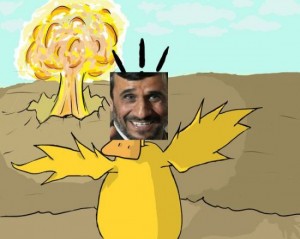
It’s a bird. It’s a plane. It’s Ahmadineduck!
Prime Minister Benjamin Netanyahu told the AIPAC conference in Washington this morning that there are still people who believe that Iran is not working to develop nuclear weapons:
Amazingly, some people refuse to acknowledge that Iran’s goal is to develop nuclear weapons. You see, Iran claims to do everything it’s doing, that it’s enriching uranium to develop medical isotopes.
Yeah, that’s right.
A country that builds underground nuclear facilities, develops intercontinental ballistic missiles, manufactures thousands of centrifuges, and that absorbs crippling sanctions, is doing all that in order to advance…medical research.
So you see, when that Iranian ICBM is flying through the air to a location near you, you’ve got nothing to worry about. It’s only carrying medical isotopes.
Ladies and Gentlemen,
If it looks like a duck, walks like a duck, and quacks like a duck, then what is it?
That’s right, it’s a duck. But this duck is a nuclear duck.
So, ladies and gentlemen, I present you with the Iranian nuclear duck. I call him: Ahmadineduck!
12.03.2012
Please watch this, do something and share it !

CATEGORIES: Documentation English Film Politics Press Social Culture WTF
12.03.2012
Israel mulls charity concert for Syrians

Foreign Ministry source confirms that singer-songwriter Arkadi Duchin called and volunteered to recruit leading Israeli performers for a charity rock concert.
Singer-songwriter Arkadi Duchin has asked Foreign Minister Avigdor Lieberman for help in organizing a charity concert to raise money for anti-government forces in Syria.
A senior Foreign Ministry official said Lieberman and his aides may approve the idea, as part of a wider effort to express public Israeli support for the rebels and denounce the slaughter of Syrian people by President Bashar Assad’s regime.
A Foreign Ministry source confirmed that after Lieberman issued a press release on Friday offering humanitarian aid to the Syrian people, Duchin called the ministry and volunteered to recruit leading Israeli performers for a charity rock concert.
Lieberman’s office did not reject the idea out of hand and forwarded the proposal to members of the ministry’s professional staff, with an eye to approving it.
Duchin confirmed that he contacted Lieberman’s office about the issue but declined to elaborate. In response to a question from Haaretz the Russian-born performer said he had not pinned down a date for the concert, which is still in the earliest planning stages. “I made the offer from a human and humanitarian place,” Duchin said.
For the past two months Lieberman has been highly visible in calling for support of the Syrian rebels and in castigating Assad, in contrast to the weak comments by Prime Minister Benjamin Netanyahu. The foreign minister has urged Assad to step down and offered to assist Syrian refugees who reach the area along the border with Israel.
Last week Lieberman instructed staffers to offer the International Committee of the Red Cross humanitarian aid to Syrian civilians. After consulting with Syrian rebel leaders, ICRC officials notified the Foreign Ministry that the offer was declined. The rebels said they did not want any connection to Israel; accepting aid from Israel would only confirm Assad’s claims that Israel and the West were behind the revolt against his regime, they explained.
12.03.2012